Productive Procrastination
Gosh, it's been a while, hasn't it?
I procrastinated on writing this long overdue post by writing an important email I'd been procrastinating on by reading the assorted high society crime stories by Dominick Dunne, available with a Vanity Fair subscription. Which I bought, because I take my procrastination seriously.
I bemoan the way my brain works sometimes. It would be so much easier if I could just simply do the highest priority thing at the top of my to-do list. But, much like the dishes, if I could "just do it", I would. It has taken a while to realise that maybe I can't.
This is deeply annoying, and makes scheduling difficult – and how I love a schedule – but I have mostly come to terms with the idea that procrastination might actually be part of my creative process.
Take my Dominick Dunne deep dive. I'm writing a murder romance right now, so crime writing is! actually! relevant and useful. Dunne in particular is fascinating, because he is often personally entangled in the lives of criminals, victims, and the people who can't stop talking about them.
This, of course, plays merry havoc with journalistic objectivity. Sometimes the story is tangentially about a murder, but really about who likes and dislikes Dunne himself, and why the latter are mistaken. Sometimes the sordid crime and scandal feels like a handy background to his true mission of dropping as many society and celebrity names and connections as possible. Check THIS out (CW for post-transition misgendering):
No one else in the trial came near to the sheer dramatic power of Alexandra Isles. Often described in the media as a soap-opera actress, the patrician Mrs. Isles attended the same schools as Sunny von Bülow: Chapin and St. Timothy's. Her mother, the Countess Mab Moltke, was born into the Wilson family of San Francisco, whose fortune, diminished now, traces its roots back to the Comstock Lode. Mrs. Isles is divorced from Philip Isles, a member of the wealthy Lehman banking family; his father changed his name from Ickelheimer in the 1950s. Following their divorce, Isles married the former wife of Dr. Richard Raskind, who changed his name to Renee Richards when he became a woman.
-- "Fatal Charm: The Social Web of Claus von Bülow", Vanity Fair, August 1985.
That's seven people, two wealthy families, three society locations and the Comstock Lode which if you're curious (I was) is a massive lode of silver ore in Nevada. In one paragraph.
Sometimes I read about the scammers and killers Dunne reported on and I'm like, wow, the idea of a mastermind criminal is so unrealistic. Most of these people, even the ones who are planning ahead, are not making smart decisions. They call their mistresses and explain they've decided not to go through with it. They haven't figured out how to get rid of the body, so they go to Walmart and buy black trash bags and duct tape, which they dutifully pay for, under full view of security cameras. They conspire with untrustworthy people to do crimes and then are surprised when those people can't be trusted.
And then I'm like, well, these are only the ones that got caught.
My other reading craze at the moment, and in entirely the other direction, is mid-century British light novels, preferably post-WWII. It's nice to read about people worrying about the same things I am (the high cost of living, work/life balance, trying to find stability and security in a world revealed to be unstable and insecure) with a little bit of distance.
I like the attention paid to work and to working women. The assumption in many of these novels is that women will give up paid work when they're married to a suitably wealthy man but until that happy day, the heroic women take their jobs seriously, and it's the flighty types who don't do their best who the reader is supposed to scorn. I suspect this might be at least partly because the people writing these novels are working women. Writing is their work, and they take it seriously.
They don't necessarily take all working women seriously. Women (usually of a lower class than the heroine) doing domestic labour in another woman's home are often comic figures or vaguely threatening, louring presences. But even still, domestic labour is recognised and valued, which is why it's noticed when someone is doing it badly or with a violence that threatens the peace and stability of the home.
If this sounds like your cup of overbrewed British tea, I recommend having a look at the publishers Persephone Books for beautifully produced physical titles, and Dean Street Press for ebooks. Persephone does also sell ebooks of many of their titles, but it's not their main focus, and the books are at a slightly higher price point than I can handle when I'm devouring three or four in a row, like cream buns at a church fair.
In terms of authors, I am fond of Dorothy Whipple, Molly Clavering, Stella Gibbons (of Cold Comfort Farm fame - five of her later novels are with DSP) and Susan Scarlett (who is Noel Streatfield, writing romances under a pen name). Also, not post-war, but if you haven't read Winifred Watson's Miss Pettigrew Lives For A Day, what a wonderful treat awaits you.
The other thing I've been doing, while I try to get this book finished, is #Frocktober. In Australia, this is a fundraiser for ovarian cancer, where people get sponsorship to wear frocks, but I am not in Australia and also know how much admin I can handle right now (exactly none) so instead I am wearing a dress every day and posting them on my 'gram, and I'll make a donation at the end of the month.
Usually when I get into GOBLIN MODE on a deadline, the first thing to go is any sense of whimsy or style, which I ordinarily really enjoy. #Frocktober has been an exercise in maintaining something I like while also hitting my word count goals.
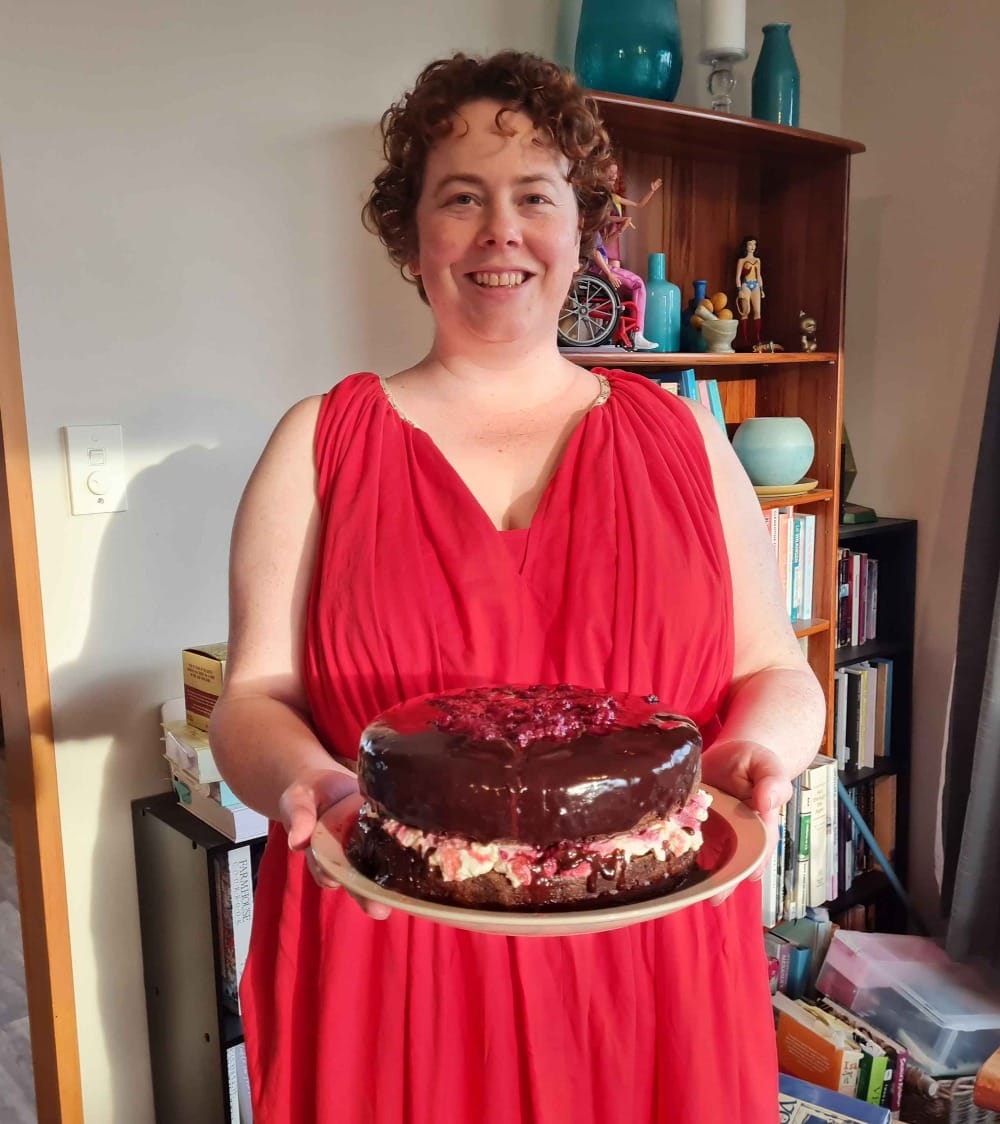
Working women! Maybe I can't have it all (like an empty sink). But it turns out I can have a lot.