What I Wore to Colours of Love
I wasn't as such nervous about attending the Romance Writers of New Zealand conference. I was already friends with several attendees, I'd gone to meetings of the local chapter—heck, I hemmed the tablecloths for the conference dinner.
But I did very much want to make a good impression. And I wanted to be memorable. And there were two themed events we were encouraged to dress up for.
So I started sewing.
First on the docket was a dress for the cocktail evening, the Golden Age of Romance. I write and love contemporary romance, but from a literary standpoint, my Golden Age of Western romance is Regency England, where Austen casually invented the genre, and then a couple of centuries later Georgette Heyer less-casually pastiched Austen's style and setting to invent the Regency-set historical romance.
I want to take a moment to note that these books are not morally neutral or apolitical. They're heteronormative, slut shaming, classist, dedicated to white supremacy (one of Austen's rich side characters is rich because he enslaves people) and in Heyer's case, unforgivably anti-Semitic. You could make a weak argument that Austen didn't know any better, but her unfinished drafts for Sanditon feature a Black heiress from the West Indies, showing that at the very least she was marginally aware of slavery's social impact. But Heyer in particular can't be argued away as totally okay because she was writing a long time ago. The Grand Sophy contains some absolutely vile anti-Semitic scenes, and it was published in 1950, when the horrors of the Holocaust were well understood and very much part of the public discourse.
I think it's important to temper my genuine love of these works and this genre by noting the above, because cosplaying the past without reckoning with it is dangerous. Witness all the people praising pioneer bossgirl designer Chanel without mentioning she was a Nazi collaborator who may have only avoided war crime charges because of old mate Winston Churchill. I'm appalled by the trad wives encouraged to fling themselves into a filter-hazy dream of "pioneer days" or "the 1950s" without consideration or care for what it would actually mean to be a woman, or queer, or a religious minority, or anything other than a straight, white, able-bodied man of means in that setting.
As you will shortly see, I am a huge fan of the 50s silhouette, and I would rather chew off my own arm than live in that time period. And that's one of the nicer eras to be a queer white woman.
Still, I wanted a Regency ballgown.
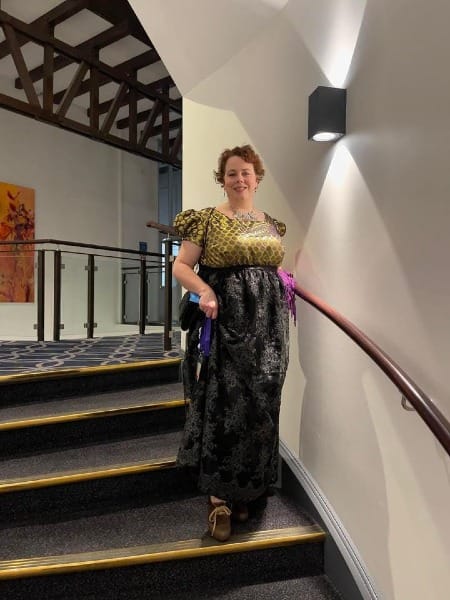
Fortunately, I had previously constructed a dramatic black Regency gown to play an ex-opera singing widow of an rich elderly gentleman for a murder mystery evening. Was picking sequins and beads out of the seam allowance a sane and sensible way to spend hours of my limited free time? It was not! But it meant I now had a starting point for the dress. To play to the "golden" theme, and also to fix the fit on the sleeves, I covered the bodice front and replaced the sleeves with a glorious gold-and-purple lurex polka dot fabric.
Here I am descending a staircase in approved Regency holding-up-the-front-of-my-dress style, while wearing distinctly non-period shoes and struggling with my lanyard.
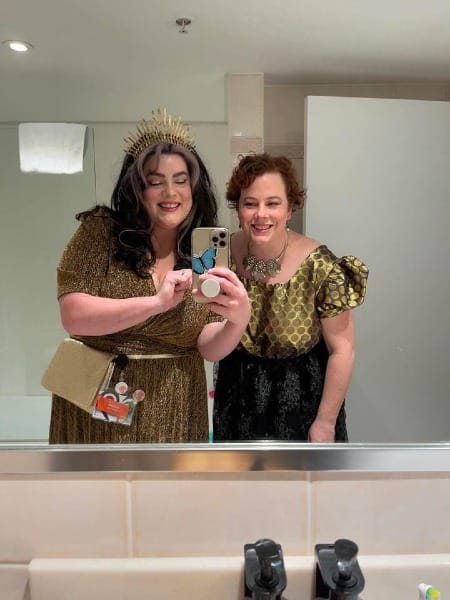
And here I am getting ready with new friend and DELIGHTFUL human Esme Brett, who did my eyeliner.
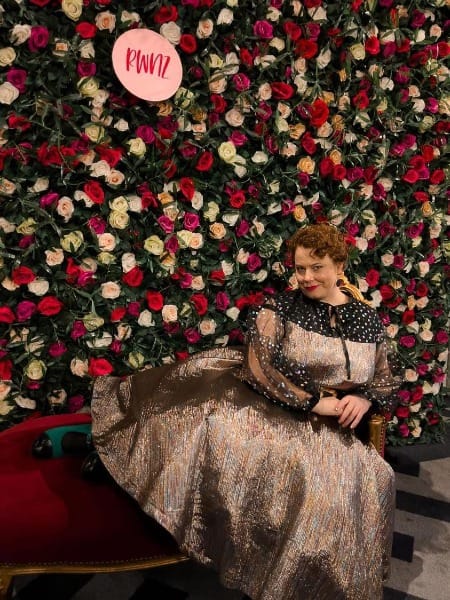
The conference dinner theme was "Colours of Love" (hence the many-hued tablecloths I'd hemmed) and I had vague ideas about rainbow fabric. I wandered the clearance aisle of Spotlight, and found metallic multi-coloured lurex for and tulle with holographic rainbow hearts. Let it never be said that I am not extra af.
I used the Grace Bodice from Charm Patterns, adding a neck tie ribbon instead of a collar and placket, and using a full circle skirt without a waistband. The aim was a BIG dress with the theme "If Grace Kelly were a disco ball", and I succeeded. The tulle turned into ballooning bishop sleeves, and the stiff metallic fabric folded into gigantic folds on the skirt.
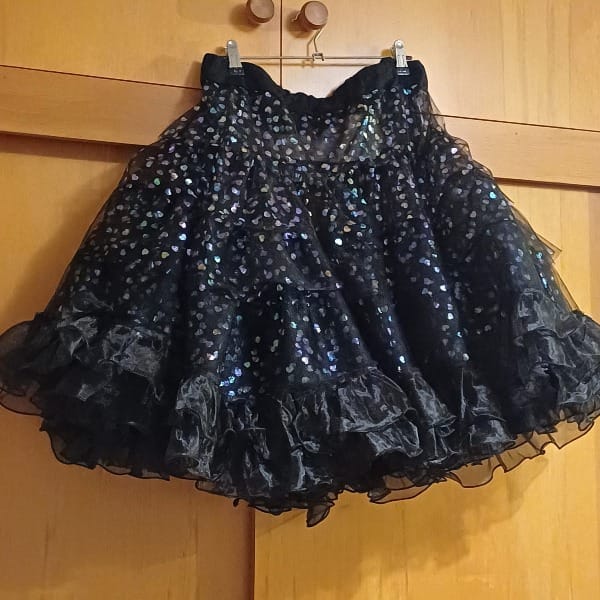
But in my heart of hearts, I knew the skirt could be even bigger. I distinctly recall thinking that it surely couldn't take that long to make a petticoat, which just goes to show that you should never take my word on timekeeping.
I swished into the dinner with considerable verve, ready and willing to steal your girl.
But the dress I like the most isn't an evening gown made of luxe fabrics. It's a modified Scout Dress made out of pink and red polka dot cotton poplin.
Those of you who have been around for a while will remember that I wanted to make a dress to match the gorgeous Liz Casal design on the cover of Bespoke and Bespelled, my book about costume designer and stitch-witch Marnie Taylor.
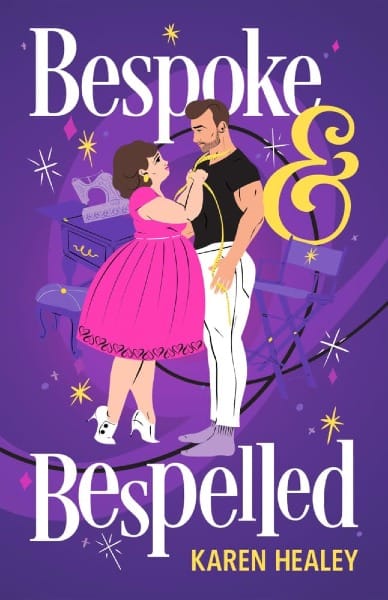
I did in fact complete that dress to the hemming point, but I'd made poor fabric choices - the material was the perfect colour, but it just wasn't stiff enough to hold up to pleats and structure, and the bodice bagged and gaped. To put the cherry on the NOPE sundae, I inserted my worst zip ever. Loathe as I am to admit failure, that dress is a big F. I will resalvage the skirt for something else and the rest will go in the scrap bag.
But I think this dress is its spiritual successor - if not an exact twin of the dress on the cover, at least a close cousin.
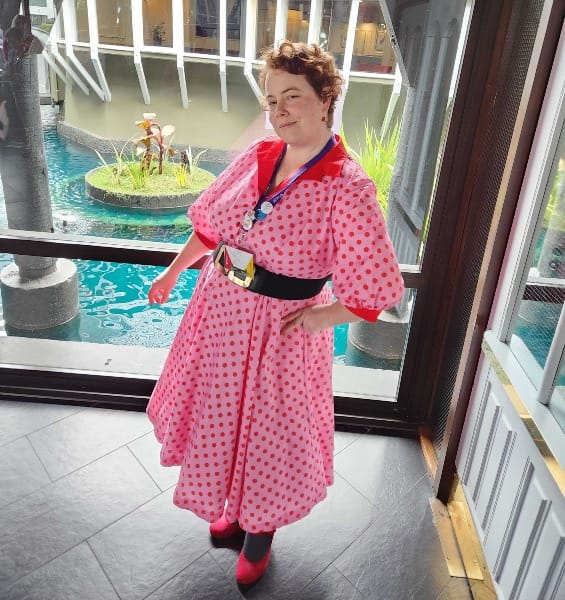
I wore it on the first day of conference, and I got a lot of compliments. It's striking everyday wear, I look cute as hell, and I'm also incredibly comfortable.
Honestly, I think Marnie would be proud. No magic required!